
Last updated:
Short answer: For bulk soil delivery in Denver, choose by job: compost is an amendment mixed into existing soil, screened topsoil adds mineral volume, and a documented blend makes a planting medium. Test the soil already in place and request a product analysis before ordering. One cubic yard covers 324 square feet at one inch deep.
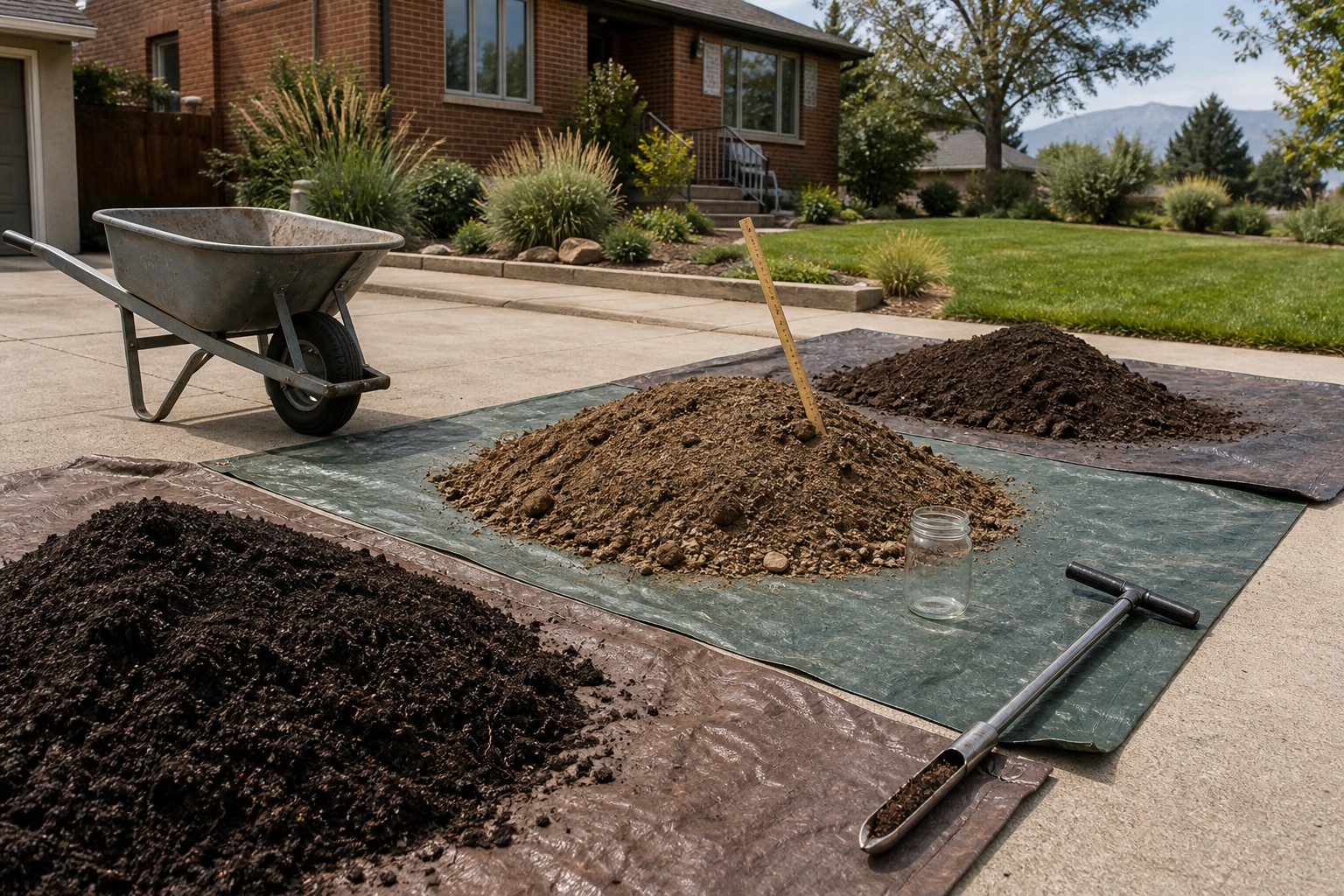
A truckload labeled “soil” could be screened mineral topsoil, finished compost, a manufactured planting blend, or a product whose proportions are not disclosed. Those loads are not interchangeable. Denver buyers should start with the intended root zone, test the soil already in place, and request a product analysis before ordering by the cubic yard.
Write the job before calling a material yard
The same property may need three different products. A lawn renovation with existing grade usually needs measured amendment, not several inches of imported topsoil. A raised bed needs a complete growing medium with known ingredients. A settled construction area may need mineral soil to restore volume before any compost rate is considered. Mixing these purposes produces bids that cannot be compared.
| Project condition | Material category to price | Evidence to request | Common wrong order |
|---|---|---|---|
| Existing lawn or bed; soil remains but needs better structure | Finished compost at a soil-test-informed rate | Feedstock, organic matter, soluble salts, maturity, and recommended use | Unspecified “garden soil” spread over living turf |
| Grade is low because mineral soil was removed | Screened topsoil or engineered fill suitable for the location | Source, texture, screened size, debris limits, and compaction plan | Pure compost used to build several inches of grade |
| New vegetable or annual bed | Documented planting blend or soil plus a calculated compost amendment | Ingredient proportions, test report, and final mixed depth | Unknown dark blend assumed to be ready because it looks rich |
| New sod after construction | Existing soil correction plus limited amendment as supported by testing | Subgrade condition, cultivation depth, amendment rate, and final grade | Thin topsoil cap placed over compacted construction soil |
| Surface moisture and weed control only | Mulch, kept on the surface | Material, particle size, installed depth, and clearance from trunks | Wood mulch tilled into a new root zone as if it were finished compost |
The existing Denver soil guide is the diagnostic starting point. This article covers the purchase decision that follows: what a delivered product must do, how much the geometry requires, and what proof belongs on the order.
Compost changes soil; topsoil adds soil
Colorado State University Extension defines a soil amendment as material mixed into soil to improve physical properties such as infiltration, drainage, aeration, and structure. It defines mulch separately as material left on the surface. Finished compost is the standard organic amendment, but it is not a universal replacement for mineral soil and it is not legally equivalent to fertilizer.
This distinction prevents a frequent scope error. If a yard is two inches below the required grade across a large area, filling the entire deficit with compost can create an over-amended layer. If the mineral soil volume is already present but compacted, adding more topsoil on top can leave the same root restriction underneath. The yard plan must identify which condition exists before the delivery is released.
What should you ask a Denver supplier before buying bulk compost?
Ask for numbers, not adjectives. CSU Extension treats 40% to 60% organic matter on a dry-weight basis as a useful compost target. Request the feedstock plus a recent lab or supplier sheet showing organic matter, soluble salts, pH, carbon-to-nitrogen ratio, screening size and batch date. If the report can’t be tied to the delivered pile, it isn’t evidence.
CSU Extension recommends evaluating organic amendment quality through measurable properties. For compost, it identifies 40% to 60% organic matter on a dry-weight basis as a useful target. It also warns that manure- and biosolids-based products can carry high soluble salts, and that products sold as compost are not guaranteed to have reached the same state of decomposition.
A bulk quote should therefore identify the feedstock and provide a recent laboratory or supplier specification sheet. At minimum, ask for organic matter, electrical conductivity or soluble salts, pH, carbon-to-nitrogen ratio, particle size or screening, and the batch or date represented. If the supplier cannot connect the delivered pile to the report, the report is not evidence for that load.
Visual inspection still matters. Reject loads with obvious trash, large uncomposted pieces beyond the stated screen, strong sour or ammonia odor, or material inconsistent with the approved sample. But appearance is a receiving check, not a substitute for analysis.
Why do soluble salts matter when buying compost in Denver?
High soluble salts damage roots and slow establishment, and Denver’s dry climate can’t be counted on to leach them out of the root zone. CSU advises caution with manure-based composts. Plant-based products are usually lower in salts, not guaranteed low. A compost can be dark, fine and fully finished yet still wrong at the proposed rate.
High soluble salts can damage roots and make establishment harder in a dry climate where rainfall may not reliably leach the root zone. CSU specifically advises caution with manure-based composts and recommends obtaining specifications or analytical results. A product can be dark, fine, and fully composted yet still be unsuitable at the proposed rate because of salts.
Do not solve this by assuming all plant-based compost is safe. CSU notes that plant-derived products are usually lower in salts, not guaranteed to be low. The accepted application rate should connect the product test to the site’s soil test and planting use.
How much area does a cubic yard of soil or compost cover?
One cubic yard is 27 cubic feet, which covers 324 square feet at one inch deep. By direct geometry, 1,000 square feet takes 3.09 cubic yards for a 1 inch layer and 6.17 for 2 inches. CSU rounds that to three yards per 1,000 square feet. It’s volume math only, not a recommended amendment rate.
One cubic yard equals 27 cubic feet. Spread uniformly, one yard covers 324 square feet at one inch deep. CSU expresses the same relationship at project scale: three cubic yards cover about 1,000 square feet one inch deep. Real beds have curves, slopes, settling, and waste, so the order should distinguish calculated volume from the accepted finished condition.
| Area | Depth before incorporation | Geometric volume |
|---|---|---|
| 500 square feet | 1 inch | 1.54 cubic yards |
| 1,000 square feet | 1 inch | 3.09 cubic yards |
| 1,000 square feet | 2 inches | 6.17 cubic yards |
| 200 square feet | 4 inches | 2.47 cubic yards |
These figures are direct geometry: area multiplied by depth in feet, divided by 27. They do not prescribe an amendment rate. CSU’s application table varies by use, incorporation depth, product type, and soil test. Use the math only after the horticultural rate has been selected.
How deep should compost be mixed into Denver soil?
There’s no single depth, but a proposal should state both the material depth before incorporation and the cultivation depth. A one-inch compost layer mixed through six inches of soil builds a different root zone than the same layer scratched into the top inch. CSU says amendments must be thoroughly mixed. Don’t till aggressively through established tree roots.
A one-inch compost layer mixed through six inches of soil creates a different root zone than the same compost scratched into the top inch. CSU says an amendment must be thoroughly mixed to do its intended work; simply burying it or leaving it on top can interfere with water and air movement. The proposal should state both the pre-incorporation material depth and the cultivation depth.
Existing trees change that plan. Aggressive tilling through established root zones can cause damage. Permanent native or drought-adapted plantings may also perform poorly when placed in an overly rich pocket that differs sharply from surrounding soil. Let the Denver landscape-design scope establish plant needs and protected root areas before specifying a blanket amendment.
Do not cap compaction with a cosmetic layer
After construction, a shallow imported layer can make the surface look finished while roots meet dense subsoil just below it. Before ordering, push a soil probe at several locations, inspect a representative profile, and record where excavation, traffic, or utility work changed the site. If water sits at the interface between layers, more surface material is not the first repair.
For a new lawn, connect the material order to preparation, final grade, and establishment duties on the Denver sod-installation page. Where standing water or building runoff is already present, separate the soil purchase from the Denver drainage and grading decision. Soil should not be used to conceal an unresolved water path.
Control delivery before the truck arrives
Bulk material is difficult to reject after it has been dumped and mixed. The purchase order should name the product, approved source, volume, test document, delivery date, placement location, access limit, and rejection process. Protect pavement with an appropriate staging surface, keep the load clear of storm inlets, and confirm that the truck’s weight and turning path will not damage walks, irrigation, or tree roots.
Photograph the empty staging area, the delivery ticket, the pile before spreading, and the completed depth checks. Retain a sealed sample labeled with the delivery date until plants establish. If a later dispute concerns salts, debris, or inconsistent texture, that sample is more useful than a generic website description.
A five-part acceptance record makes bids comparable
- Site baseline: mapped area, existing grade, compaction observations, soil-test date, and protected roots.
- Product identity: named material, source, feedstock or ingredient proportions, batch, and current analysis.
- Quantity: measured square footage, prescribed application depth, calculated yards, delivered yards, and allowance.
- Installation: spread depth before incorporation, mixing depth, equipment limits, and final grade.
- Readback: photographs, delivery ticket, retained sample, representative depth checks, and drainage observation after irrigation or rain.
That record turns “soil near me” into a controlled material purchase. Distance and delivery fee still matter, but they come after the product is fit for the root zone.
Questions Denver soil buyers ask
Is compost the same as topsoil?
No. Compost is decomposed organic matter used primarily as an amendment. Topsoil is mineral soil from the upper soil profile or a screened product sold to add soil volume. A blend contains stated proportions of components and should be judged by its specification.
Can I judge good compost by its dark color?
No. Color cannot establish salt level, organic-matter percentage, maturity, feedstock, or batch consistency. Request current analytical information and connect it to the proposed use.
How many cubic yards cover 1,000 square feet?
About 3.09 cubic yards make a one-inch layer by direct geometry; CSU rounds this to three cubic yards. This is a volume conversion, not an application recommendation.
Should new topsoil be spread over compacted ground?
Not without diagnosing the layer below. A thin cap can leave roots and water trapped at the interface. The written estimate should address subgrade condition, cultivation, final grade, and drainage.
Sources and measurement basis
- Colorado State University Extension: Choosing a Soil Amendment — product definitions, compost evaluation, salt cautions, organic-matter range, and use-specific application guidance.
- Colorado State University Extension: Soil Amendments — quality factors, laboratory measures, decomposition, foreign material, and carbon-to-nitrogen guidance.
- Colorado State University Extension: Using Compost in Colorado Gardens — bulk purchase, salts, maturity, and nutrient-release context.
- Volume calculations use 27 cubic feet per cubic yard and do not include settling, waste, grade correction, or a horticultural application-rate decision.