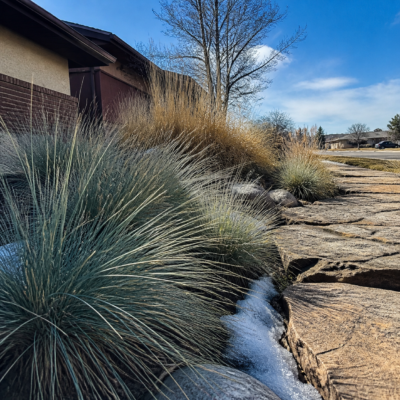
Planning a new sprinkler or drip system in Denver means working around Denver Water’s 2026 drought rules, a clay soil that takes water slowly, and a backflow requirement that is not optional. The system itself is installed by a licensed contractor you hire, not by us. This guide covers the planning side: what to decide, what the rules say, what to ask in a quote. Call (720) 650-0165 or request a free quote to talk it through before you collect bids.
Who should install an irrigation system in Denver?
A licensed irrigation or plumbing contractor who handles the backflow assembly and the permit paperwork for your address should install it. Ask each bidder which license or registration they hold with the city or county, and verify it with that office before you sign. Do not accept a verbal yes.
Backflow is where the rules bite. Denver Water requires an approved backflow prevention assembly on irrigation service, tested at installation and every year after by a certified tester. In the City and County of Denver, backflow preventers are listed under plumbing quick permits. Suburbs have their own permit desks, so the answer in Parker or Broomfield can differ from the answer inside Denver city limits. We have not confirmed a single state-level irrigation license for Colorado, so treat the city, county or water provider as the authority and ask them directly.
This page does not quote installation prices. The number depends on the contractor and what they find in your yard. For wider market ranges across all landscaping work, see our Denver landscaping cost guide.
Can I run sprinklers under Denver Water’s 2026 drought rules?
Not on a lawn right now. Denver Water declared a Stage 1 drought and ended lawn watering season early, so lawn watering and all spray irrigation had to stop after September 30, 2026. Drip irrigation and hand watering of trees, shrubs and perennials stay legal, and a system may be run for installation, repair or attended testing.
- A system may be operated for installation, repair or reasonable maintenance, as long as someone attends it the whole time it runs.
- Trees, shrubs and perennials can be watered any day with a hand-held hose and shutoff nozzle, or with low-volume, non-spray irrigation such as drip.
- Annuals and vegetables can be watered the same way until the first frost.
- From October 1, single-family fines are $500 for a first violation and $1,000 for a second. After that it is $1,000 plus suspension of service.
- New grass is on hold too. Denver Water says grass establishment is not allowed after September 30 except under an approved variance.
- Denver Water says sprinklers need to stay off in spring 2027 until its board decides how and when lawn watering resumes.
The reason is supply. Denver Water reported April to July streamflow at 22 percent of normal, the lowest in the 110-year record, and reservoir storage at 72 percent full in late August against a historic median of 94 percent. Before the ban, the summer rules allowed two assigned days a week and nothing between 10 a.m. and 6 p.m. Suburbs on their own water utility set their own schedules, so confirm your provider before anyone programs a controller. Our Denver lawn watering guide and watering rules page cover schedules and local rules.
For now, new work tends toward drip zones for beds and trees, with turf zones built, tested and ready for the day watering reopens.
Is drip irrigation worth it in Denver, CO?
Yes, for beds, shrubs, trees and narrow strips. Colorado State University Extension rates drip at over 90 percent efficiency, against 50 to 70 percent for sprinklers, because water goes to the root zone instead of into the air. On Denver’s slow clay it also avoids runoff, and it is the irrigation Denver Water still allows.
Where drip beats spray on Front Range clay
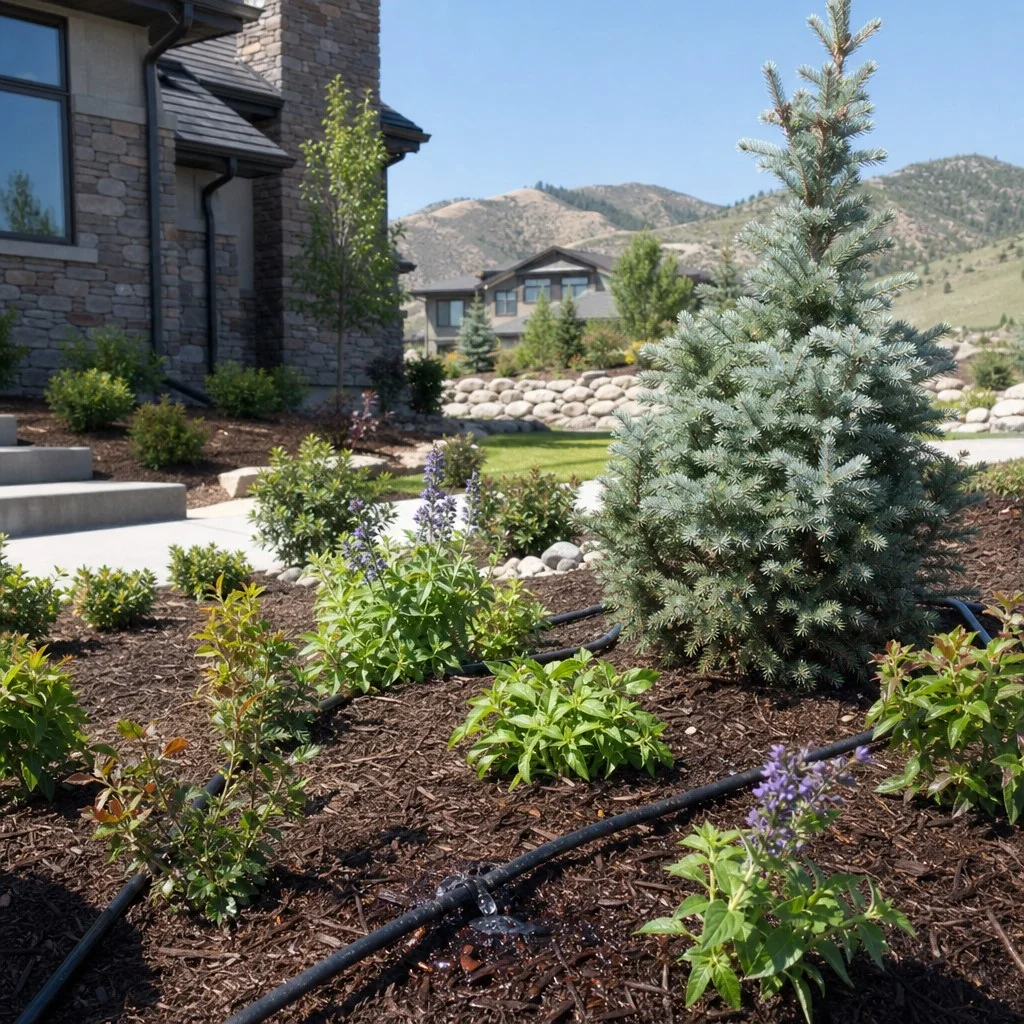
Spray heads put water down faster than clay can take it. The USDA describes the Denver soil series as slowly to very slowly permeable, with more than 35 percent clay in the subsoil, so a spray zone on even a gentle slope starts sending water to the sidewalk before the soil is wet. Drip applies water at a gallon or two an hour, right at the plant, so it has time to soak in. It keeps leaves dry, does not blow away on a windy afternoon and does not wet the fence, the siding or the foundation.
Where drip does not win is open lawn. Turf still wants rotors or rotary nozzles. A good Denver system uses both, each where it fits.
Emitter spacing and flow to ask about
CSU Extension’s spacing guide is the usual starting point: emitters 12 inches apart in sand, 18 inches in loam and 24 inches in clay, because water spreads sideways farther in clay. Emitters are sold by flow rate, typically half a gallon, 1, 2 and 4 gallons per hour. The same guide gives these layouts:
- Perennials: two half-gallon emitters at the base, so the plant still gets water if one clogs.
- Shrubs of 1 to 5 feet and small trees: two 1 gallon per hour emitters about 12 inches from the base.
- Shrubs over 5 feet: three 1 gallon per hour emitters.
- Medium trees, 15 to 25 feet at maturity: four emitters set two feet from the trunk.
Drip runs at about 20 to 30 psi, well under typical household pressure of 50 to 60 psi, so every drip zone needs a pressure regulator, a 150 to 200 mesh filter and backflow protection. A half-inch poly mainline tops out around 200 gallons per hour per zone, and past that a designer steps up to three-quarter inch line or splits the zone.
Converting spray zones to drip
Plenty of bed zones in Denver yards were built with pop-up sprays. Converting one means capping the spray heads, fitting a drip head assembly with a filter and regulator, running poly mainline through the bed and punching in emitters at each plant. The valve, the wire and the controller station all stay, and the schedule gets reset, since drip and spray run on very different clocks. CSU’s rule of thumb for established plants is about one hour of drip run time a week. Next to the house, go lighter still: Denver’s own homeowner runoff guide says to use irrigation sparingly near the home and never to use a spray head near the foundation.
Denver Water rules and rebates for drip
Under the Stage 1 drought rules, low-volume, non-spray irrigation such as drip is the one automatic system Denver Water customers can still run on a schedule. Denver Water’s outdoor rebate pays for rotary sprinkler nozzles, not drip parts, so drip does not earn cash back on its own. Replacing turf with drip-watered planting can: the turf replacement discount through Resource Central is worth up to $750 on projects that remove at least 200 square feet of lawn, though the 2026 allocation is fully used. Our Denver xeriscape rebate guide tracks when it reopens.
What does the irrigation process look like, step by step?
A typical project runs eight steps: a site walk, a pressure and flow test, zone design, utility locates, trenching and pipe, the backflow preventer, the controller, and an attended test run. Pressure is tested before design, because it decides how many heads a zone can carry and which heads make sense. The licensed contractor does the work, and you make the decisions at steps one and three.
- First call and site walk. The contractor walks the yard with you and notes sun, slope, soil, plant types and any existing lines. You decide what needs water and what does not. Plan on about an hour.
- Pressure and flow test. A gauge on the tap and a flow measurement. Those two numbers set how many heads each zone can carry. It takes a few minutes and heads off the most common design mistake, too many heads on one zone.
- Zone design and written quote. The yard is split into zones by plant type and exposure, heads are chosen and pipe is sized. The zone count is decided here, and it is most of the price. Ask for the zone list in writing.
- Utility locates. Colorado law requires contacting Colorado 811 at least three business days before digging, and it is free. Nothing gets trenched until the marks are on the ground, so that wait is built into every schedule.
- Trenching, pipe and valves. Trench, pipe, valve boxes and wire from each valve back to the controller. Clay digs slowly when it is dry and sticks to everything when it is wet, so soil moisture sets the pace. On most residential lots this is typically one to three days of site work.
- Heads, drip and backflow preventer. Heads go in at matched spacing, drip tubing goes through the beds, and the backflow assembly is set at the height its type requires. Denver Water expects that assembly to be tested at installation.
- Controller and programming. The controller is mounted, wired and programmed by zone type, with short repeated cycles on clay, and set to your water provider’s current rules. Right now that means drip zones only for Denver Water customers.
- Attended test run and walkthrough. Every zone runs while someone watches for leaks, misting and dry corners. Then you are shown the controller, the shut-off and the backflow preventer. Allow about an hour.
What sprinkler heads and parts work best in Denver yards?
Rotors for open turf, rotary nozzles for slopes and small lawns, pop-up sprays only on narrow strips, and drip for everything that is not grass. Rotary nozzles apply water more slowly than fixed sprays, which suits clay, and they are the nozzles Denver Water’s rebate covers. Ask the contractor which brand they specify and whether parts will be easy to find in ten years.
- Rotors. Gear-driven heads that throw a rotating stream across larger lawn areas. Best on open turf with room to space them.
- Rotary nozzles. Several slow rotating streams from a spray body. Good on slopes, small lawns and mixed sun. Hunter MP, Rain Bird, Toro Precision and K-Rain models are on Denver Water’s rebate list.
- Pop-up sprays. A fixed fan of water at a high application rate. Keep them to narrow strips where nothing else fits.
- Drip tubing and emitters. For beds, shrubs, trees and containers.
- Pipe. Rigid PVC and flexible polyethylene both have their place. The difference matters at blowout: CSU Extension caps blowout pressure at 80 psi for rigid PVC and 50 psi for polyethylene.
- Backflow assemblies. Denver Water lists pressure vacuum breaker (PVB) and reduced pressure (RP) assemblies for irrigation. CSU Extension notes a PVB has to sit vertical and at least 12 inches above all downstream piping, while an RP device gives the highest level of protection.
- Controllers. Wi-Fi smart controllers pull local weather and adjust run times on their own.
Do I need a permit or a backflow preventer for sprinklers in Denver?
You need the backflow preventer. Denver Water requires an approved backflow prevention assembly on irrigation service and expects the customer to have it tested at installation and every year after by a certified tester. In the City and County of Denver, backflow preventers are listed under plumbing quick permits. Confirm what your address needs with the city or your suburb’s permit desk.
Denver Water’s irrigation backflow testing season runs May to September, and it assesses single-family requirements by site hazard. For irrigation it names reduced pressure assemblies or pressure vacuum breakers, depending on the installation, and says double check valves are not allowed. CSU Extension adds that these devices will be damaged by freezing unless they are drained, which is why the backflow preventer is the first thing handled at blowout. When you collect quotes, ask who handles the annual test and the report to Denver Water.
When should sprinklers be blown out and started up in Denver?
Blow the system out in early to mid October. Denver Water puts the typical first freeze in mid October, and water left in the lines, valves or backflow preventer can crack them. Spring startup follows once hard freezes ease, around the average last frost in early to mid May, and in 2027 it also waits on Denver Water.
What a fall blowout involves
The irrigation supply is shut off, a compressor is connected and each zone is cleared in turn. CSU Extension’s guidance is blunt: do not trust manual or automatic drain valves, blow the system out. It puts working pressure at 40 to 80 psi, with 80 the ceiling for rigid PVC and 50 for polyethylene pipe, and it says PVB and RP backflow devices must never be blown out with compressed air. Those get drained instead.
What a spring startup involves
The system is brought up slowly, then each zone is run and every head checked for coverage, rotation and leaks. Freeze and thaw over a Denver winter routinely crack fittings and push heads out of line, and it is better to find that in spring than in July. Our Denver frost dates page has the averages if you are timing it yourself.
Why does Denver’s clay soil change how a sprinkler system is designed?
Because clay takes water slowly. The USDA describes the Denver soil series as slowly to very slowly permeable, with more than 35 percent clay in the subsoil. Run a zone too long and the water leaves as runoff. A sound design uses low application rates, short repeated cycles and drip, and keeps water away from foundations.
A dry climate with a short wet season
Denver’s normal precipitation adds up to about 14.5 inches a year. May is the wettest month at 2.16 inches and July is close behind at 2.14, while December and January each average under half an inch. CSU Extension notes a bluegrass lawn can need up to 2.25 inches of water a week in hot, dry, windy weather. That gap between what falls and what turf wants is the reason head spacing, matched nozzles and weather-based controllers matter here. Extension’s advice for most soils is not to apply all the water at once: put down part, wait an hour or so, then apply the rest.
Expansive clay and your foundation
The Colorado Geological Survey says bentonite clays can expand up to 20 percent by volume when they get wet. Its homeowner guidance on swelling soils is to keep grass, shrubs, flowers and sprinkler systems at least 5 feet from the foundation. Design to that: no spray heads against the house, and only light drip for beds that sit close to it.
Are there Denver Water rebates for irrigation upgrades?
Yes, for nozzles. Denver Water offers up to $3 back per rotary or high-efficiency sprinkler nozzle on purchases of 10 to 100 nozzles, once per residence in a 10-year period. The product has to be new and replace an old fixture, and the application is due within 90 days of purchase with a paid receipt. Its outdoor residential rebate page does not list a smart controller rebate.
On a lawn with 30 spray nozzles, that is up to $90 back for a swap that also slows the application rate to something clay can absorb. Funds are limited and the program can end at any time, so confirm on Denver Water’s outdoor rebates page before you buy.
Can an existing sprinkler system be repaired by a different contractor?
Yes. Most repair calls are on systems another contractor put in. A good technician finds the problem with pressure gauges, valve locators and line tracers, fixes it, and suggests upgrades only where they help. Our sprinkler repair page covers the yearly service side.
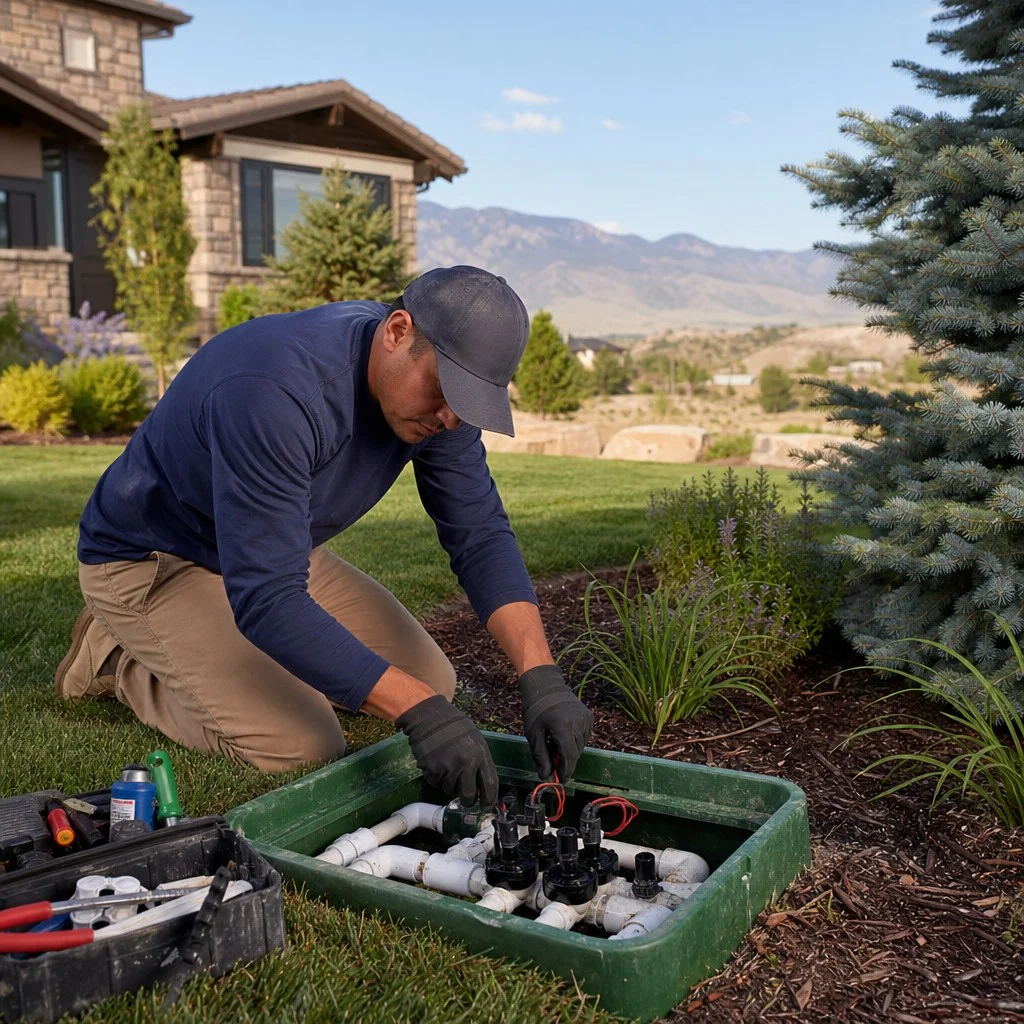
- Broken or tilted heads. Usually a mower strike or frost heave.
- A zone that will not shut off or will not come on. Often a stuck solenoid, debris in the valve or a failed wire splice.
- Low pressure on one zone. A line break, a clogged filter or a valve problem.
- Dry spots on a system that used to cover. Heads drifted out of line, clogged nozzles or plants that grew into the spray.
- A controller running the wrong schedule. Dead backup batteries, a power surge or last season’s program left in place.
What does a typical Denver irrigation scope look like?
Three scopes cover most homes: a six-zone system on a clay lot, converting two bed zones from spray to drip, and a rotary nozzle retrofit with a year of seasonal service. These are typical scopes, not quotes and not accounts of particular jobs, written to show what a quote should list.
A typical six-zone system on a 6,000 square foot clay lot
Picture front and back lawn in full sun, two planting beds and a street tree, all on flat, heavy clay. The scope is two rotor zones for the back lawn, two rotary nozzle zones for the front lawn and side strip, two drip zones for the beds and the tree, plus a backflow assembly, valve boxes, wire and a Wi-Fi controller. The local complication is the water rules: for a Denver Water customer, only the drip zones can run on a schedule until the board reopens lawn watering. The turf zones get an attended test and then wait.
A typical conversion of two bed zones from spray to drip
A pair of established beds along the house and the fence, watered by pop-up sprays that wet the siding. The scope is to cap the spray heads, fit a filter and pressure regulator on each zone, run half-inch poly mainline under the mulch, set emitters per plant at 24-inch spacing for clay, and reprogram both stations for drip run times. The local complication is the foundation: beds inside 5 feet of the house get the lightest schedule on the property.
A typical rotary nozzle retrofit plus a year of service
A working five-zone system with old fixed spray nozzles on the lawn. The scope is to swap 30 spray nozzles for rotary nozzles and reset run times, then a spring startup and a fall blowout. The rebate fine print is 10 to 100 nozzles, once per residence in 10 years, so it pays to do the whole lawn in one go. Denver Water’s rebate returns up to $90 on 30 nozzles.
What maintenance does a Denver irrigation system need each year?
Four things: a spring startup, a backflow test, a mid-season check of heads and emitters, and a fall blowout before the first freeze. Denver Water expects backflow assemblies tested annually, and its irrigation testing season runs May to September. A skipped blowout is how pipes and backflow preventers crack.
Drip needs its own short list. Flush the filter, walk the beds each spring to find emitters that got knocked off or chewed, and move emitters outward as shrubs and trees grow. CSU Extension’s winter advice for simple drip setups is to take the head assembly indoors and uncap the mainline so it drains. And when the watering rules change, the controller schedule has to change with them.
What should I compare when I collect irrigation quotes in Denver?
Compare the zone count, the backflow assembly type and who tests it, the controller model, the pipe type, how drip zones are built, and which permits the contractor pulls. A quote that is silent on backflow or on the permit is incomplete, however low the total looks.
- License. The license or registration the contractor holds, checked with the issuing office before you sign.
- Zone list. Turf, bed and tree zones separated, with head types named.
- Backflow. PVB or RP, where it sits, and who files the annual test with Denver Water.
- Drip build. Filter, regulator, emitter layout and a flush point.
- Controller. Model and whether it reads local weather.
- Rules. Whether the schedule matches your provider’s current restrictions.
Which Denver suburbs and areas do these rules cover?
The Denver Water rules and rebates on this page apply to Denver Water customers across Denver and the suburbs it serves, including Aurora, Lakewood, Centennial, Highlands Ranch, Littleton, Englewood, Wheat Ridge, Arvada, Thornton and Westminster. Suburbs on their own utility follow their own rules, so confirm yours first.
Local pages: Broomfield, Castle Rock, Commerce City, Northglenn, Parker, and all the areas we serve.
Irrigation ties into the rest of the yard. A new landscape design usually means re-zoning for drip, hardscape means re-routing lines, and lawn mowing and leaf removal visits are where damaged heads get spotted.
Want to plan a system before you collect bids? Call (720) 650-0165 or request a free quote and we will help you scope it.