
Last updated: September 30, 2026
Short answer: Choosing a native flowering shrub for a Denver yard starts with the site, not the bloom. Measure the space, classify the root zone as dry, moderate or consistently moist, and record sun and drainage. Then pick by size: serviceberry grows 6-10 feet, Apache plume and golden currant 4-6 feet, and silvery leadplant stays under 4 feet.
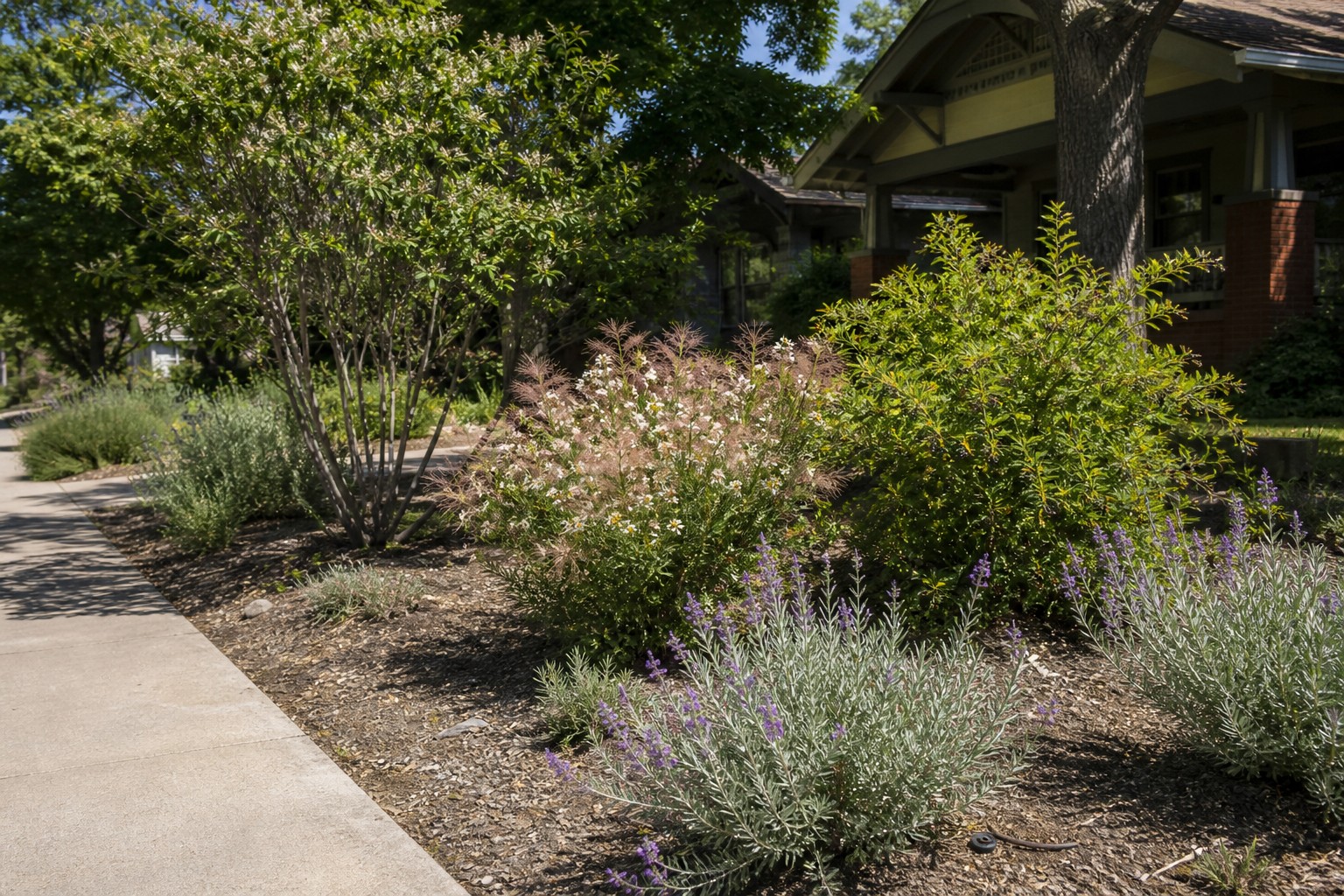
“Native to Colorado” is not enough to place a flowering shrub in a Denver yard. The state spans plains, foothills, mountains, dry canyons, and stream corridors. A native plant succeeds when the home site approximates the moisture, exposure, elevation, soil, and space where that species is adapted. The shortlist below begins with those filters and treats bloom as the final choice, not the first.
Which native flowering shrubs work in a Denver yard?
Seven natives cover most Denver sites, sorted by Colorado State University Extension size class. Serviceberry is large at 6-10 feet. Apache plume, golden currant and boulder raspberry are medium at 4-6 feet. Silvery leadplant, littleleaf mock orange and waxflower stay under 4 feet. Most want low to moderate moisture and sun, though boulder raspberry and waxflower tolerate shade.
Colorado State University Extension groups native shrubs by mature size and publishes planting altitude, moisture requirement, growth behavior, flower, fruit, and exposure notes. The following matrix uses those fields directly. It is a site-screening tool, not a guarantee that every nursery carries every species or that every property at the same elevation has the same microclimate.
| Shrub | CSU size class | Moisture and exposure | Useful Denver position | Reason to reject it |
|---|---|---|---|---|
| Serviceberry Amelanchier alnifolia |
Large: 6-10 feet | Low to moderate moisture; generally sun | Back of a mixed border where white flowers, blue-black fruit, and orange-red fall color can be seen | Space is too narrow for an upright-to-spreading large shrub |
| Apache plume Fallugia paradoxa |
Medium: 4-6 feet | Low moisture; sun | Open dry bed where white flowers and pinkish seed heads can carry interest through summer | Bed is wet, heavily shaded, or requires a clipped formal outline |
| Golden currant Ribes aureum |
Medium: 4-6 feet | Low to moderate moisture; generally sun; well-drained site | Layered wildlife border needing yellow spring flowers, fruit, and orange-red fall color | Water sits in the root zone or fruit drop conflicts with a paved use area |
| Boulder raspberry Rubus deliciosus |
Medium: 4-6 feet | Low to moderate moisture; shade tolerant | Bright shade where arching stems and large white spring flowers have room | A narrow passage cannot accept an arching shrub |
| Silvery leadplant Amorpha canescens |
Small: under 4 feet | Low moisture; sun; tolerant of drought and poor soil | Dry front layer with gray-green foliage and violet-purple midsummer flower spikes | Bed receives regular high-water irrigation or dense shade |
| Littleleaf mock orange Philadelphus microphyllus |
Small: under 4 feet | Low to moderate moisture; generally sun | Compact dry-to-moderate bed where fragrant white flowers can be experienced close to a sitting area | Fast fill or a large screen is the main requirement; CSU describes it as slow-growing |
| Waxflower Jamesia americana |
Small: under 4 feet | Moderate moisture; shade tolerant; well-drained soil | Protected light shade with white late-spring flowers and red fall color | Exposed hot pavement edge or a saturated pocket |
How much space do native shrubs need in a Denver bed?
Plan around mature size class, not the nursery label. CSU puts serviceberry in the 6-to-10-foot large group, Apache plume and golden currant in the 4-to-6-foot group, and silvery leadplant below four feet. Measure clear horizontal space, including gate swing, snow storage and hose routes. If the mature size conflicts, choose a smaller species instead of shearing forever.
A shrub label photographed at purchase is not a planting plan. CSU places serviceberry in its 6-to-10-foot large-shrub group, Apache plume and golden currant in the 4-to-6-foot group, and silvery leadplant below four feet. Those categories should determine bed depth, spacing from walks, window clearance, and the order of the planting layers.
Measure the clear horizontal space, not merely the empty soil. Include the arc of a gate, snow-storage area, service access, hose route, vehicle sight line, and the shoulder space people need beside a walk. If the mature size conflicts, choose a smaller species rather than budgeting for permanent corrective shearing.
Do low-water native shrubs still need watering after planting?
Yes. CSU notes native shrubs may need supplemental moisture after planting, and watering can drop only once they’re established on a matching site. A low-water label describes the mature plant. Put each shrub on the right hydrozone: Apache plume and silvery leadplant are low-moisture, waxflower needs moderate moisture, and one mixed valve defeats the selection.
CSU notes that native shrubs may require supplemental moisture after planting. Once established, watering can be reduced when the site matches the species’ native conditions. That distinction belongs in the irrigation schedule. A low-water label describes the mature relationship, not permission to let a new root ball dry out.
Put each shrub on the correct hydrozone. Apache plume and silvery leadplant are low-moisture choices; waxflower requires moderate moisture; streamside species outside this shortlist may require much more. A mixed valve that waters all three identically defeats the site selection. The Denver watering guide covers current scheduling context, but shrub establishment should be documented separately from lawn cycles.
Shade is not one condition
Morning sun with afternoon protection differs from the dry darkness beneath a mature tree. Boulder raspberry and waxflower are shade tolerant according to CSU, yet waxflower needs well-drained soil and moderate moisture, while boulder raspberry has arching growth that needs room. Neither label resolves root competition, reflected heat, or winter wind.
Record four observations: hours of direct light during the growing season, whether the exposure is morning or afternoon, the depth of existing tree roots, and how quickly the spot dries after irrigation. Choose from that record. Do not move a species into shade simply because a sunny bed is full.
Bloom sequence must survive the site filters
A multi-season border can begin with golden currant’s yellow late-spring flowers, move through littleleaf mock orange and serviceberry whites, then carry violet leadplant spikes and Apache plume’s flower-to-seed display into summer. But the sequence is valid only where each plant’s moisture, exposure, and space requirements also fit.
That is why this is not a recipe for seven shrubs in one bed. A dry exposed frontage might use Apache plume and leadplant but omit waxflower. A protected east-side border might support waxflower and boulder raspberry but have no room for serviceberry. A responsible Denver planting plan records the selection and the rejected alternatives.
Which native shrubs spread or form thickets near walks?
Several do. CSU describes western chokecherry and smooth sumac as thicket-forming, Woods rose as both spiny and thicket-forming, and rabbitbrush as potentially aggressive. Those traits help wildlife habitat and erosion control but don’t belong beside a narrow sidewalk. Add a behavior line for every shrub, stating where natural spread is allowed and where it must stop.
Several native shrubs spread, sucker, arch, form thickets, or carry thorns. Those traits can be valuable for wildlife habitat or erosion control and unacceptable beside a narrow sidewalk. CSU describes western chokecherry and smooth sumac as thicket-forming; Woods rose is both spiny and thicket-forming; rabbitbrush can be aggressive. They are not bad plants. They are plants with a larger management boundary.
For every proposed shrub, add a behavior line to the schedule: upright, arching, spreading, suckering, thicket-forming, thorny, or slow-growing. State where natural spread is allowed and where it must stop. This protects the planting from a maintenance plan that later removes the very form it was chosen to provide.
Native does not authorize wild collection
CSU explicitly advises that native shrubs should not be collected from the wild because removal reduces biodiversity and creates disturbed ground that may be invaded by weeds. Buy nursery-grown material with a botanical name and known source. If a listed shrub is not locally available, ask nurseries about future stock rather than substituting an unidentified plant or digging one from open land.
Record the botanical name because common names overlap. A cultivar may also differ from the straight species in mature size, flower, fruit, or form. The installed plant list should match the approved schedule exactly or document the substitution and its new requirements.
Do not over-amend a plant adapted to lean ground
A native’s correct site may be lower in fertility or coarser in texture than a conventional ornamental bed. CSU’s native-shrub guidance says establishment depends on approximating the natural environment. Its soil guidance also cautions that amendment decisions should be site-specific rather than automatic.
Inspect the soil and root ball before writing the installation method. If purchased plants arrive in a peat-and-bark medium, plan how the interface will be managed without creating a rich pocket surrounded by very different soil. Use the Denver bulk-soil procurement guide to distinguish tested amendment from topsoil or a manufactured blend.
A two-season readback is better than an install photo
Installation day can confirm identity, location, spacing, planting depth, irrigation connection, and mulch clearance. It cannot prove mature fit. Recheck after the first summer and after winter. Record tip dieback, winter burn, snow breakage, browsing, flower timing, fruit, irrigation frequency, and any encroachment on a walk.
If a turf-conversion incentive is part of the project, verify the current rules before removal or purchase on the Denver xeriscape-rebate page. A plant can be horticulturally suitable without automatically satisfying a program’s current eligibility or timing requirements.
Questions about Denver native shrubs
Does Colorado native mean the shrub will thrive anywhere in Denver?
No. Colorado spans distinct life zones and moisture conditions. Match the species’ altitude range, exposure, water need, drainage, mature size, and growth behavior to the actual bed.
Which small native shrub offers summer purple flowers?
CSU lists silvery leadplant in the under-four-foot group and describes violet-purple flower spikes in midsummer, low moisture use, and tolerance of drought and poor soils.
What native flowering shrub works in light shade?
CSU identifies boulder raspberry and waxflower as shade tolerant. They are not interchangeable: boulder raspberry is a 4-to-6-foot arching shrub, while waxflower is under four feet and needs moderate moisture with well-drained soil.
Can I collect a native shrub from undeveloped land?
No. CSU advises against wild collection because it reduces biodiversity and disturbs the site. Purchase nursery-grown plants identified by botanical name.
Sources and selection method
- Colorado State University Extension: Native Shrubs for Colorado Landscapes — reviewed August 2025; size classes, planting altitude, moisture, life zone, form, flowers, fruit, exposure notes, and collection guidance.
- Colorado State University Extension: Deciduous Shrubs — reviewed August 2025; landscape function and the requirement to consider available space, exposure, and soil.
- The shortlist retains CSU’s disqualifiers and size categories. Site observations and plant identity must be verified for the individual property before purchase.